
A CDN should deliver more than an impressive speed-test result. In production, teams need pages that stay fast, fewer repeat requests hitting origin, risks handled before they reach the application and enough visibility to understand traffic cost.
IXCDN brings acceleration, caching, security and traffic analytics into one delivery path. Teams can improve website, API, download and media delivery without stitching together separate tools for every operational task.
1. Route each request to a suitable edge
The geographically closest location is not always the best-performing route. Carrier boundaries, congestion and node health can have a greater impact than distance alone.
IXCDN steers traffic using service coverage, network reachability and edge health. This helps:
- reduce avoidable cross-region and cross-carrier detours;
- direct new requests away from unhealthy locations;
- operate global, regional and private routes under one service policy.
Customers receive a more stable entry path without having to manage the routing machinery behind it.
2. Reduce origin load with controlled caching
Sending every static asset, download and cacheable API response back to origin consumes compute, bandwidth and connection capacity. IXCDN applies cache policy at the edge so reusable content can be served closer to the requester.
Caching is managed per domain. Teams can control whether caching is enabled, how long eligible responses remain fresh and which content should always return to origin. Dynamic APIs, authenticated content and latency-sensitive paths can remain uncached.
The aim is not to cache everything. It is to keep the policy aligned with the application:
- deliver static content from the edge where appropriate;
- preserve correct origin behavior for dynamic requests;
- provide explicit controls for policy changes and cache invalidation;
- measure hit ratio and origin traffic to confirm that caching is saving real cost.
3. Put security in front of the origin
IXCDN applies domain ownership checks, TLS, access policy and WAF inspection at the edge entrance. A domain must pass ownership verification before it can proceed to active delivery, reducing the risk of accidental or unauthorized onboarding.
WAF policy can start in detect mode. Teams can observe events, check application compatibility and then move to blocking when they are ready. This is safer than enabling an aggressive rule set on day one and discovering false positives through customer reports.
Security remains operationally understandable:
- inspect security events with request context;
- tune protection by domain;
- investigate anomalies by IP, path and status;
- review security changes alongside access logs.
4. Keep configuration work out of the traffic path
An edge network must accept regular updates to domains, certificates, cache policy and security controls. Production traffic should not require a live control-console request each time it is served.
IXCDN separates configuration management from request processing. The control plane manages and publishes changes, while edge locations serve traffic using their active runtime configuration. If management services are temporarily unavailable, locations that already hold valid configuration can continue serving existing workloads.
This gives customers centralized control without turning the management interface into a dependency for every request.
5. Measure delivery efficiency, not just total traffic
Traffic volume alone does not show whether a CDN is doing useful work. IXCDN Console brings requests, egress, cache hit ratio, status codes, access logs and WAF events into one operational view.
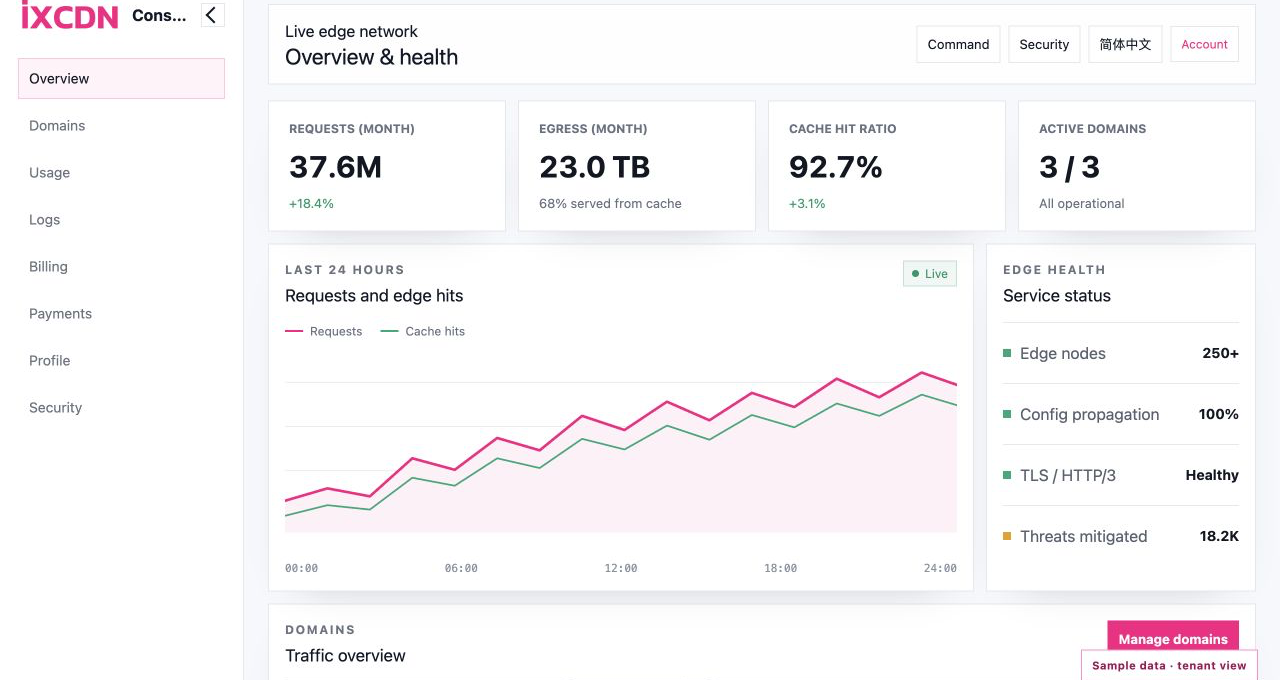
Teams can answer questions that affect production and cost:
- Which domain is driving growth?
- How much traffic was served at the edge instead of returning to origin?
- Are 4xx and 5xx responses caused by clients, origin failures or hostile traffic?
- Is an anomaly concentrated around one node, path or client IP?
- Is current usage approaching a plan or budget threshold?
6. Control long-term cost with IX and edge capacity
IXCDN approaches cost by removing avoidable work from the delivery path:
- use exchange and peer connectivity where it improves reachability;
- reduce repeat origin egress through edge caching;
- stop invalid or hostile requests before they consume origin capacity;
- attribute usage and logs by domain so teams can optimize the right workload;
- turn existing servers, bandwidth and partner locations into manageable edge capacity.
This model is especially useful for teams with network assets, multi-region delivery requirements or a desire to avoid depending entirely on a single cloud provider.
Where IXCDN fits
- Websites and SaaS: manage static delivery, TLS, caching and WAF policy together.
- APIs: preserve dynamic origin behavior while gaining an edge entrance, security inspection and error tracing.
- Downloads and media files: reduce repeat origin delivery across regions.
- Dynamic services and API traffic: keep correct origin behavior while gaining a clearer entrance, protection and logs.
- Owned network operations: organize servers, bandwidth and edge locations into a managed CDN service.
Validate with one domain
There is no need to migrate everything at once. Start with a representative domain, complete ownership verification and CNAME onboarding, then compare latency, cache hit ratio, origin traffic and anomalous requests before expanding.
Continue with the IXCDN Console guide, or open IXCDN Console.