
Some people take eleven seconds to decide on a relationship. I take 100 milliseconds to decide whether to close a tab.
A lot can happen in 100 milliseconds. A recursive resolver queries an authoritative server that isn’t nearby. TLS shakes hands twice. An image that should have lived at the edge insists on crossing the Pacific back to origin. The model’s first token is still in line while the user has already cleared the input box.
Clearing the box is the most expensive gesture of this era. No click, no token — just one quiet never mind.
In 100ms, the user is waiting on four things
Not the word “loading” — four independent round trips:
- Resolution. If the recursive resolver detours to a distant authoritative server, you’ve lost tens of milliseconds on the very first hop.
- The handshake. Every extra TLS round trip costs more the farther you are.
- Fetching. An image, a bundle of JS — if each one goes back to origin, you’re making the user swim the Pacific for you.
- Speaking. With an LLM, the wait is rarely the generation. It’s the silence before the first token arrives.
Slow down any one leg and the rest is erased. Users don’t read your architecture diagram. They only know: slow — never mind.
I stopped negotiating with the Pacific
Point the domain at IXCDN, and each of the four legs finds a shorter path:
- Nearest resolution. Anycast + GeoDNS smart resolution read the visitor’s network line or geography and resolve them to the nearest suitable edge ingress — carriers and overseas regions each get a different answer, with unmatched visitors falling back to the default line, instead of everyone detouring to one distant authoritative server.
- A shorter handshake. HTTP/3 (QUIC), TLS 1.3 and 0-RTT trim round trips out of connection setup; on flaky or switching networks, one lost packet no longer stalls the whole connection.
- Fetch in place. Static stays in edge cache; a hit never goes back to origin. Dynamic uses regional origin fetch — each region pulls from origin nearby and pools connections per region, with Origin Shield collapsing repeat fetches so origin is bothered once, not every time.
- Speak sooner. The model enters through a nearby AI gateway ingress — OpenAI-compatible, no code changes — so the first token arrives earlier.
These aren’t four tools to maintain separately. They’re four things on one delivery path.
GeoDNS: one host record, different answers per line
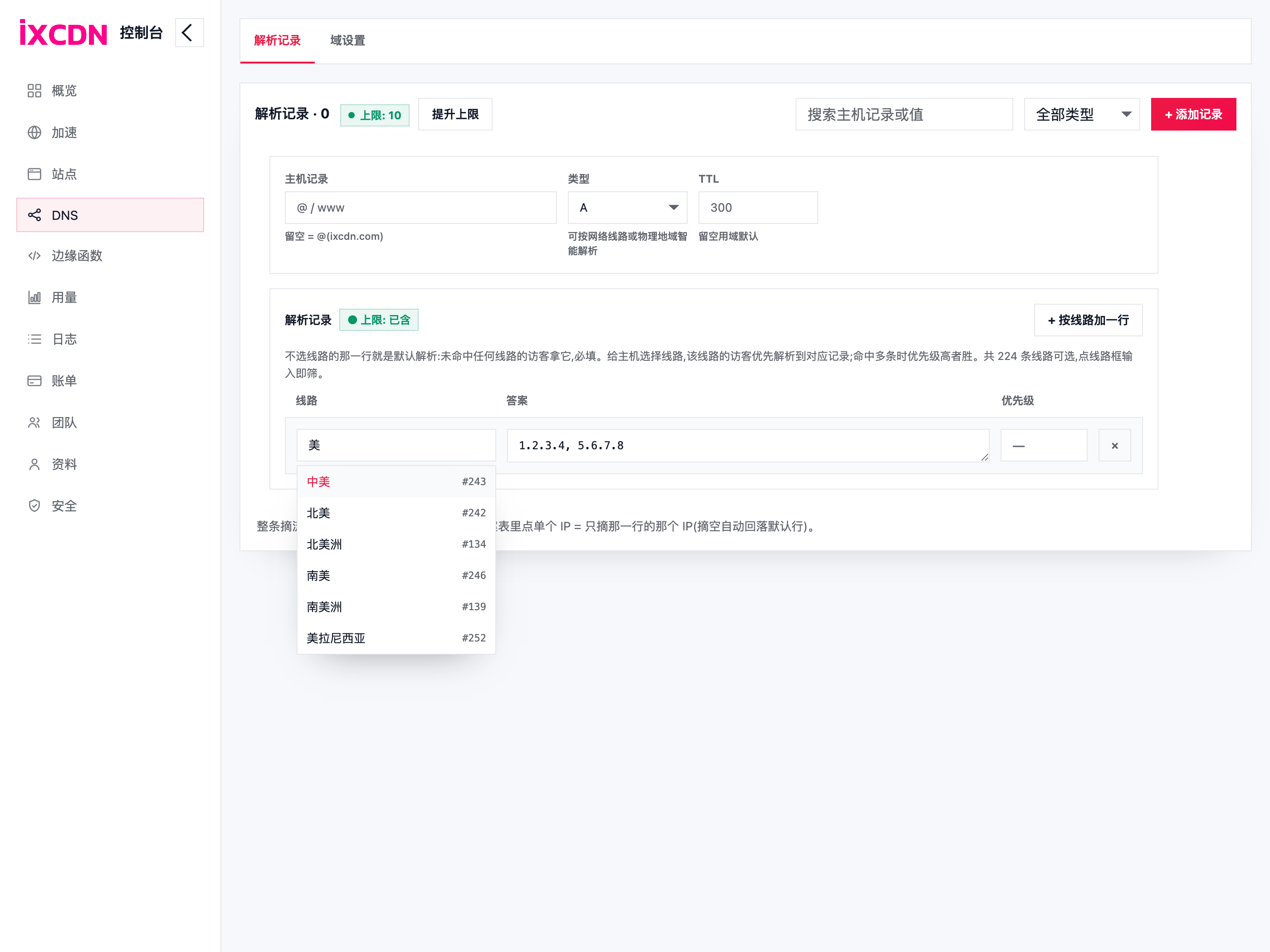
One A record shouldn’t hand every visitor the same answer. IXCDN’s smart resolution splits by line: domestic carriers and overseas regions each take their own nearest ingress; priority decides when several lines match, and anyone matching no line falls back to the default line. The same host record returns a different nearest answer per line — saving those tens of milliseconds on the first hop instead of detouring everyone to one distant authoritative server.
Regional origin fetch: keep the origin hop close too
On a cache miss, the origin hop matters just as much. Regional origin fetch lets each region pull from origin nearby and reuse connections per region, while Origin Shield collapses repeat requests at the edge so your origin is hit once. Where your origin sits matters less — what matters is that the user’s side always takes the short path.
A bill should be an honest sentence
Many acceleration bills blend things you can’t see into one flat rate.
IXCDN writes them out: delivered CDN traffic, LLM tokens, and compute — each on its own meter, never merged into one “blended rate.” The free plan is always on — enough for personal sites, tests and light production. Production usage is billed by what actually happens.
Why you’re paying — the bill says so itself.
Not simply faster — finally visible
Speed is easy to turn into a slogan. What actually changes decisions is visibility.
Full-path logs and real-time analytics show you where the user actually died: resolution detoured to a distant authoritative server, a cache miss went back to origin, or the first token took too long. You can only optimize what you can see. Blind, you just keep guessing — and keep paying that 100ms.
Three minutes, starting from seeing
No contract to sign first, no prepayment. Bring the domain in: static stays, dynamic reuses, the model enters from a nearby ingress, and the bill is written out by meter. Three minutes to start, free plan always on.
It isn’t simply faster. It’s that you finally see where the user left — and on which hop they died.
Start for free → · Explore CDN · Explore the AI Gateway
— ixcdn.com